
How to Search Criminal Dockets
Begin at Matagorda County's official Public Record Search page. Its Judicial Records route leads to the county-linked Tyler Odyssey service. That Odyssey endpoint sits behind a login. Open it in a live browser to see its current fields and any rules for pulling documents. Where the case lives depends on the charge. A felony docket is held by the District Clerk. Misdemeanors filed in county court generally sit with the County Clerk. Justice and municipal clerks keep their own fine-only matters. For any Matagorda County criminal docket search, a cause number is your strongest key. The court number and exact case style help too. Without those, search by full name and narrow the results using only the controls the live service provides. Then follow a clear access sequence:
- Identify the offense level and likely court before opening a search.
- Try the official county Judicial Records route for a participating district or county case.
- Check re:SearchTX after signing in for participating Texas cases, filings, and hearings.
- Record the cause number, court, style, and newest setting from a likely match.
- Call, visit, or submit the clerk's record form when the portal fails or a certified document is needed.
Matagorda Criminal Docket Routes
Felony records live with the Matagorda County District Clerk. The clerk serves the District Courts from 1700 7th Street, Room 307, Bay City, Texas 77414-5092, phone (979) 244-7621. The counter opens Monday through Friday, 8 a.m. to 5 p.m. It closes from noon to 1 p.m. Give staff a cause number, court number, and case style. That lets them pull the right Matagorda County criminal docket.
District records can go by mail, email, or counter request. For those, the clerk's civil-family-criminal request form is the best documented route. It asks which document you want and whether certification is required. The form quotes a 24-to-48-hour window and lists separate paper, electronic, certification, and research charges. That estimate covers record requests only. It does not promise when a new filing will surface in every public search.
What a Criminal Docket Shows
Read a Matagorda County criminal docket as a sequence of dated events, never as one label. Local, non-identifying material comes from the District Clerk request form, criminal calendar labels, and official court forms. For the case identifier, the simplest accurate presentation is CAUSE NUMBER.
| Case identity | Cause number, court, case style, filing date, and case category. |
|---|---|
| Charge | Offense or category, indictment or information, and State and defendant roles. |
| Case events | Arraignment, plea, discovery, motions, pretrial, trial, and docket calls. |
| Release entries | Bond, surrender, forfeiture, and related court action when applicable. |
| Result | Verdict, disposition, sentence, supervision events, costs, and appeal. |
| Access status | A document link, redaction, restriction, or sealed marker when exposed. |
A filed charge is not a conviction. An indictment is not a sentence. A motion entry records a request, not an order granting it. When the exact result matters, read the final disposition and the signed order.
Matagorda Criminal Docket Identifiers
The cause number, court number, and exact case style form the strongest search set for Matagorda County cases. Copy them exactly as printed. Near-identical names can pull the wrong file.
A name works when no number is known, but confirm the court and dates before trusting the match. Never assume identity from a close spelling alone.
Matagorda Criminal Docket Calendar Codes
The 130th District Court calendar splits criminal work from its other settings. Wednesday ancillary blocks carry a criminal pretrial label. Thursday blocks show MTR and MTA, shorthand for motion to revoke and motion to adjudicate. The calendar also states that criminal trials take priority. Civil and family trials come second unless noted. These labels describe scheduling only, not guilt or the outcome of any motion.
- Arraignment
- A hearing that addresses the charge and plea process, not a finding of guilt.
- Pretrial
- A case-management or preliminary setting before a plea or trial.
- MTR or MTA
- A motion to revoke or adjudicate; its result must be read in a later event or order.
- Disposition
- The recorded resolution or status event, which may be followed by sentencing or appeal entries.
Court dates can change at any time, so confirm a setting through the current Matagorda County criminal docket or the coordinator or clerk. A general calendar block never proves that one named case is set.
Stages on a Criminal Docket
A felony docket may open with a filed event. Later lines show indictment, arraignment, counsel, discovery, motions, and pretrial settings. If the case gets that far, a plea or trial follows. Disposition records what happened. Sentencing, supervision, revocation, costs, or appeal may add later lines. County misdemeanors read the same event-by-event way, though a different clerk may hold them.
Docket flow: Filing › Arraignment › Pretrial › Plea or Trial › Disposition › Sentencing
Not every Matagorda County criminal docket contains every stage. A dismissal can end a case before trial. A reset moves a setting but does not erase the case. Ask the clerk to explain any unclear system code.
Matagorda Criminal Docket Forms
The 130th District Court forms page links a standing criminal discovery order, bond and forfeiture materials, magistrates' warnings, indigence affidavits, and appointment lists. Those resources explain the procedures behind many Matagorda County criminal docket entries. A standing order or blank form never proves the same event occurred in a specific case.
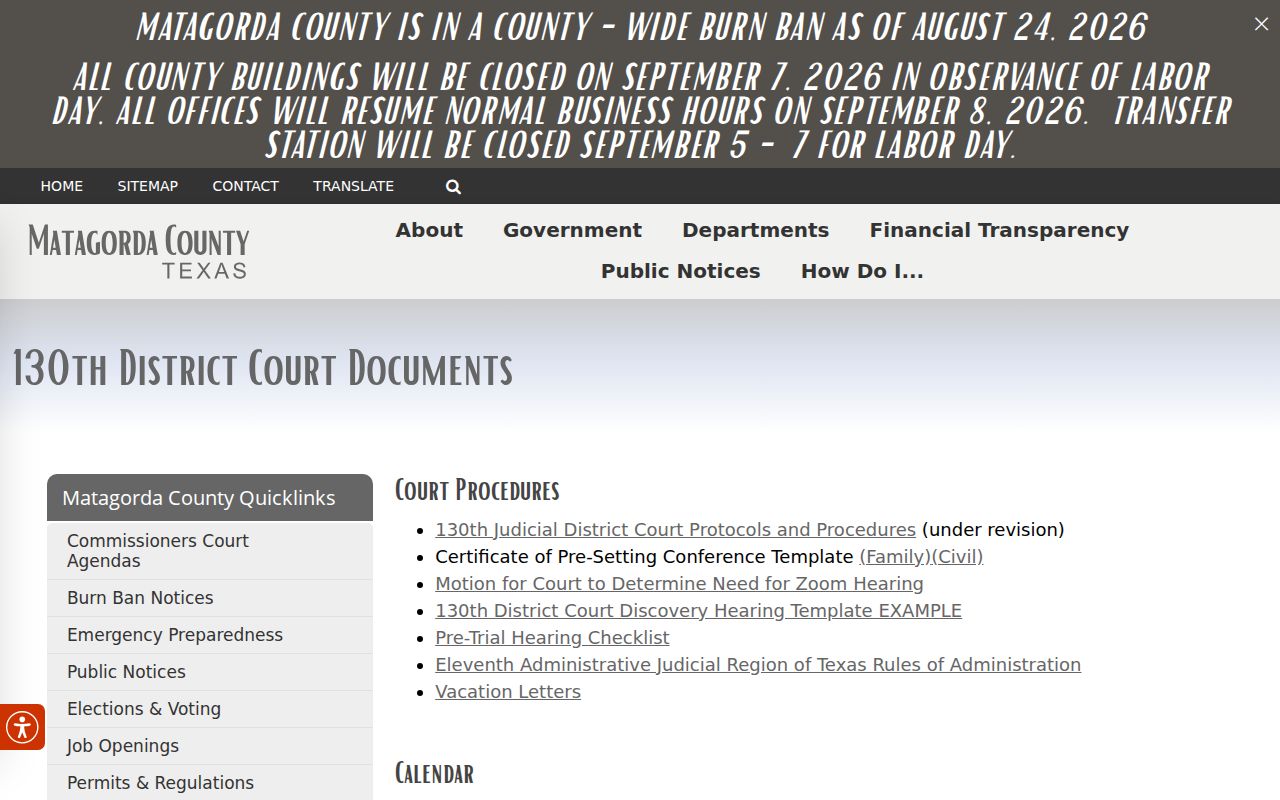
The official page helps separate court-wide procedure from the dated history on one docket sheet. It also gives a local path when a short docket code points to discovery, bond, warning, or indigence paperwork.
Which Court Holds Criminal Dockets
Matagorda County divides its criminal dockets among several clerks. The District Clerk holds felony dockets for the 23rd and 130th Judicial District Courts. The County Clerk keeps misdemeanors. Those are tied to the Constitutional County Court or County Court at Law. Five Justice Courts handle fine-only misdemeanor and traffic cases. Bay City and Palacios Municipal Courts keep their own city ordinance, traffic, and other Class C matters.
| Case level | Likely custodian | First route |
|---|---|---|
| Felony | District Clerk | Judicial Records or clerk request |
| County misdemeanor | County Clerk | County clerk or linked Odyssey access |
| Fine-only offense | Relevant Justice Court | Individual JP office page |
| City Class C case | Bay City or Palacios clerk | Issuing municipal court |
The 23rd District Court page documents one local district route.
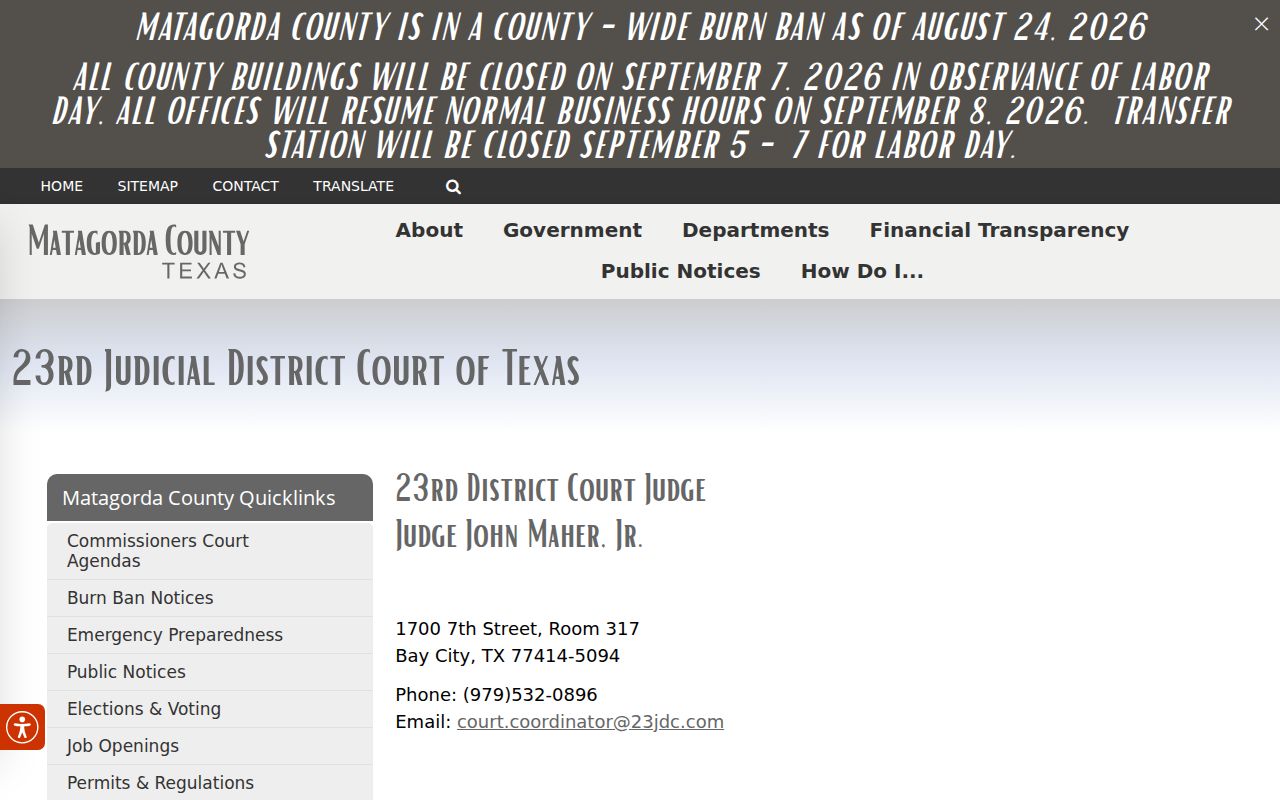
Felony records in Matagorda County sit with the district court and its clerk. That is where a felony lookup belongs. A municipal or Justice Court does hear some criminal matters, but neither holds the felony docket, so a search routed there will not find what it needs.
Matagorda Criminal Docket Settings
The 130th District Court page posts coordinator contact information and local procedures for criminal settings. Hearings there happen in person by default. A Zoom appearance requires a motion that is set, heard, and granted under the court's protocols. A Matagorda County criminal docket may list a hearing without saying how to appear. That page supplies the answer.
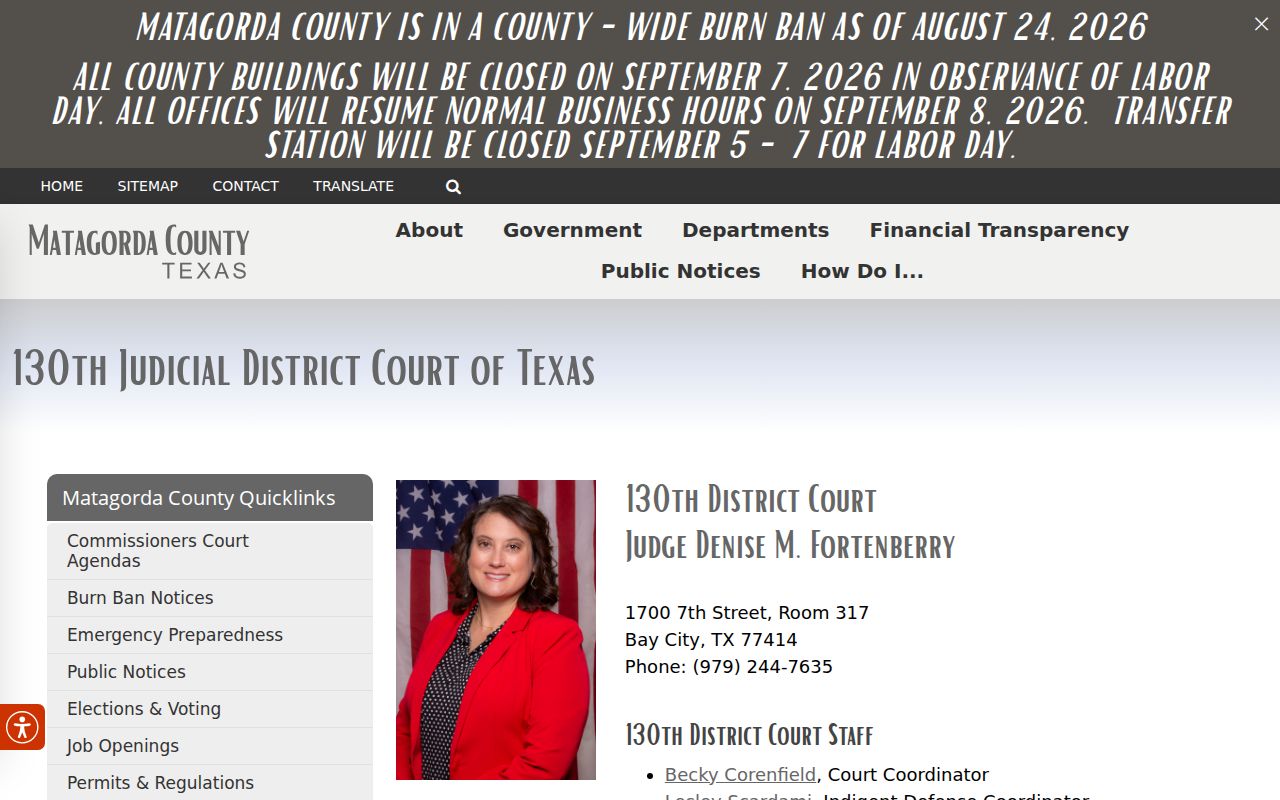
For local procedure, the court page governs. The District Clerk's docket still controls filed events and case history. If the two seem to conflict, call the coordinator with the cause number, style, setting type, and dates ready.
Matagorda Criminal Docket Payments
The County Clerk links a Certified Payments route, and the Justice Courts publish payment choices specific to each office. Confirm the balance and reference number with the office before you pay. Then keep your receipt. A receipt proves the transaction only. It is not the full Matagorda County criminal case history, and the docket may take time to reflect it.
Public Access and Sealed Criminal Dockets
Adult Matagorda County criminal docket events can be public. Access does not mean unrestricted publication. A case line may sit in plain view while a filing is sealed, a copy is redacted, or an attachment stays restricted. Juvenile and child-protection records call for more care. The Gulf Coast Children's Court public schedule does not open the protected case file behind it.
Key access rules:
Texas Rule of Judicial Administration 12 governs access to judicial records and provides written-denial and appeal procedures.
Texas Rule of Appellate Procedure 21c privacy material identifies sensitive data that must be protected or redacted.
Texas Government Code Chapter 25 supplies the statutory county-court framework.
The District Clerk offers a sealed-document form. It routes a request to a judge for review. Do not try to defeat a seal or redaction. If access is denied, ask for the reason in writing. Follow Rule 12 where it applies. Keep in mind that the Matagorda County Public Information Act process is not the default route for court records held by a clerk.
Empty Matagorda Criminal Docket Search
An empty result never proves a case does not exist. The wrong clerk can hide a match. A name variant, a narrow date range, delayed indexing, portal participation, or a legal access limit can too. Save the official URL and the visible error. Confirm whether the matter is district, county, Justice, municipal, juvenile, or federal before you search again. For a district case, give the District Clerk the cause number, court number, exact style, and document name if you know it. A county misdemeanor belongs with the County Clerk. Treat re:SearchTX as a separate cross-check. It is not a certified Matagorda County criminal docket. A payment portal is not the docket either, and it may update on another schedule. Note: Verify the newest event with the proper clerk. Do that before relying on a hearing date, charge label, balance, or disposition.
Matagorda Criminal Docket Copies
A plain copy just reproduces the document. Certification adds the District Clerk's authentication. Name the exact filing or order when you order either one. Choose the format based on how you plan to use the record. The local request form separates research, copy, and certification charges, and the clerk can quote the request if the page count or access status is still unknown.